|
OPENING
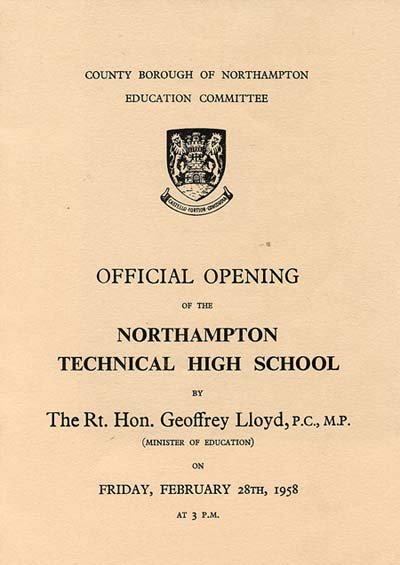
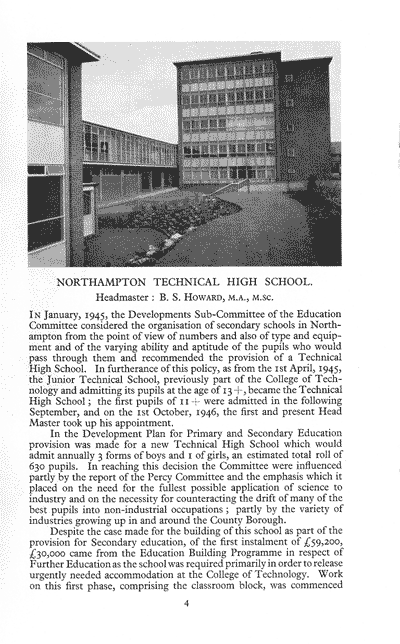
Northampton's new £227,000 Technical High School yesterday, the
Minister of Education (Mr. Geoffrey Lloyd) said it was a
practical answer to the critics of Britain's education system.
He posed the question: "Have we been adapting ourselves fast
enough to the changing, amid much more, scientific, character of
the world and particularly industry."
If anyone wants to criticise our education system, that probably
would be the main criticism made," said Mr. Lloyd. "That is why
it is particularly pleasing this afternoon to be in a
magnificent new school which is a most practical form at answer
to a criticism of that kind. I think it is true to say that this
school is really a modern form of grammar school."
In the 19th century there were strong arts and classical
components in grammar school training but, he claimed,
scientific studies were also very good for intellectual
discipline. Various schools could still have a particular
emphasis or bias.
Northampton was moving along with great success, in solving the
problem of developing technical modern schools to take full
responsibility for a share in, the present education system said
Mr Lloyd.
He was particularly interested to see in Northampton how schools
had been developed and how they had biases in different
directions.
SENSE OF BALANCE
Northampton was in a sense a very representative British town
with an historic past, prosperous present and, he hoped, a very
important industrial future.
"You have been, adapting your education system with great energy
and yet with a very typical sense of balance," he said. There
had been no wild rush for any particular form of nostrum or
educational fad: they had taken the essential decisions and made
progress - a very steady and balanced development.
Before declaring the school officially open, the Minister said:
I hope that this school will make a great contribution to the
prosperity and culture of the town in the future."
Earlier in his speech, Mr. Lloyd said Northampton's fine new
school reminded him forcibly of the impression he formed on his
travels in. Asia - that there was a tremendous interest in
education all over the world.
Britain's problem was to keep ahead of other countries in
education and to do that we had to work very hard. Yet he said
there were some heartening things in British education. He had
been impressed by the obvious interest of children in what they
were doing. Not so when lie was at school. Then there was a
difficult spirit... perhaps it way naughtiness.'
TRIBUTE TO TEACHERS
"Anybody who goes into schools today cannot fail to be struck by
the fact that children are absorbed in what they are doing, and
we have to thank the teachers for the tremendous improvements in
the art of teaching and in capturing the interest of the boys
and girls," he said.
Mr. Lloyd referred to the
greatest boom in school building ever known in
|
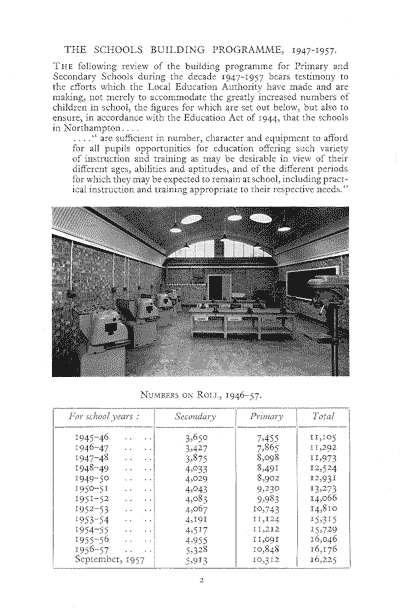
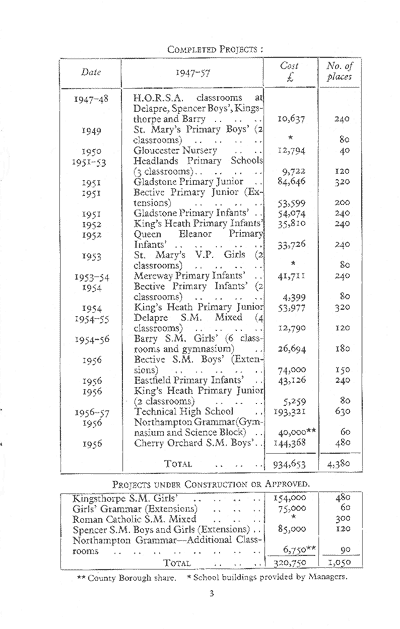
this country. Since the war we have built 2,644 primary schools
1,136 new secondary schools and had provided over 2,000,000
school places. That was a 'really wonderful effort and he hoped
it was only in mid-course.
But he said, the most wonderful thing of all was to see the
translation into reality of the great principle of the Butler
Act of 1944 of making secondary education, available to all, up
to the limit of their abilities and capacities. That was a new
principle in educational history.
It would produce year by year a new class of leading British
citizens of a higher Standard in education and ability and in
quantities never experienced before. It was going to have a
profound effect on the country.
"It gives us a warm feeling in our hearts to realise that this
is open to everyone, irrespective of their means," he said.
SILVER LINING?
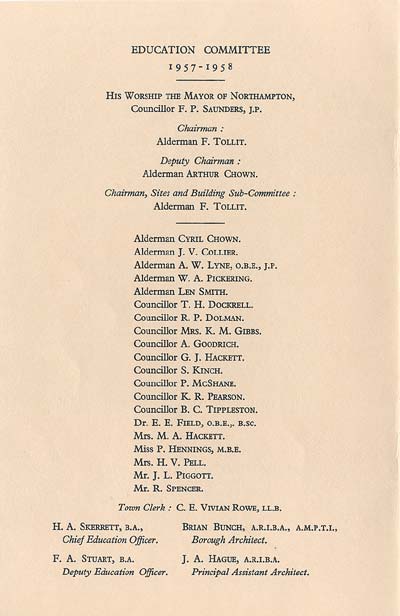
Introducing the Minister. Alderman F. Tollit, chairman of the
Education Committee, said: "We with the approval of your
department, are planning extensive additions to the Central
College of Further Education. Work will commence very shortly on
a new workshop block."
He added: " Although there are some of us who feel that there is
a thickening cloud over the field of education. We are
optimistic enough to look for a silver lining."
Alderman Tollit had said that despite difficulties, the
Technical High School - once part of the College of Technology -
had made outstanding progress during the past ten years. The
sixth farm was growing and would continue to grow. There was
also a steady flow of able scholars to the universities.
Proposing a vote of thanks to the minister, the Mayor of
Northampton (Councillor F. P. Saunders) said it had become
evident that that they were passing through a revolutionary
stage in education. The new school closely fitted into the
pattern of the modern world.
The vote of thanks was seconded by Alderman A. L. Chown,
deputy-chairman of the Education Committee, and prayers of
dedication were, led by the Mayor's Chaplain (the Rev B. R.
Marsh).
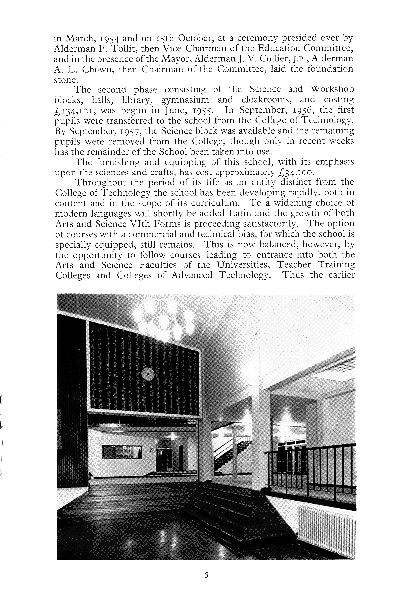
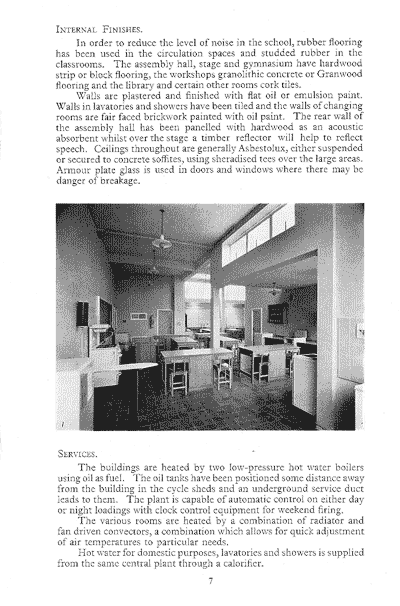
After the ceremony in the assembly hall, the Borough Architect
(Mr. Brian Bunch) and members of his stall conducted parties of
guests around the new school buildings. Among the many guests
was Mr. R. T. Paget, MP for Northampton.
|