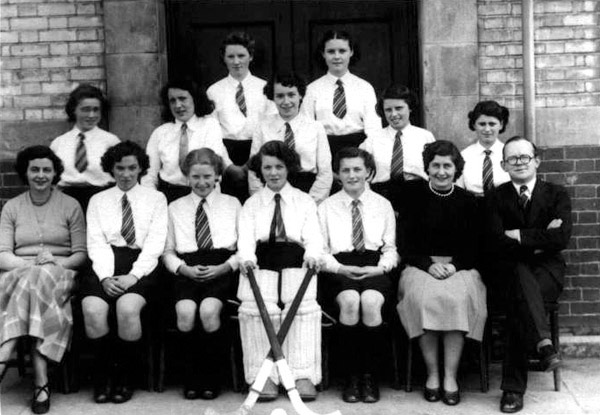
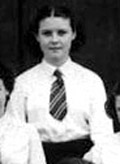
Pam, taken from a 1951 school Hockey Team photo
The text of her talk is given below.
I was born on 31st May 1936 in my grandmother’s house in the town of Northampton, an industrial town in the East Midlands of England. The midwife in attendance was my great-aunt Harriet. Aunt Harriet was not a qualified midwife because she could not afford the 2 shillings and 6 pence for her registration fee yet she delivered most of the local babies. She also laid out the dead.
In the summer holidays, before I started school we used to go camping with an aunt and uncle to a farm in Braybrook, a nearby village. Mr. Cooper (the farmer) and his wife were very friendly and looked forward to our visit every summer. Mrs. Cooper used to bring fresh eggs and milk to our camp early every morning. Sometimes mum used to make chips in an old pot on the camp- fire. Mrs. Cooper must have had her nose to the wind because she always seemed to appear from no-where when the chips were cooking.
When I was 3 World War II began. I have vivid memories of air raid sirens going off during the night and dad lifting me out of bed and taking me down our neighbour’s shelter where we remained until he heard the “all clear” siren. The shelter was a dug –out in the garden, close to the house, going deep into the ground. Curved corrugated iron was placed over the hole and the earth that was dug out was piled over the top of the iron. Grass then grew all over the top. The shelters looked a bit like igloos in shape with steps going down to the heavy front door. Inside a wooden bench seat was constructed along each side. Some folks made their shelters very comfortable with bunk beds and shelving. They were cold inside and made good cool rooms for food storage in the warmer weather. Our own back yard was too small for a shelter so we shared our neighbour’s. A while later we were issued with a table -shelter.
This was an iron table that replaced the dining table. It had heavy metal meshing around the sides and underneath, resembling a cage. A mattress was placed on the mesh below. During an air raid we were meant to get in this “cage” and lie low. It was supposed to shelter us from falling masonry. We used it a few times but dad never trusted it.
Before the call-up my father volunteered for the army but was rejected on health grounds. Due to Bright’s disease he was graded C3, the lowest grade so he continued in his job as a cobbler at a boot and shoe factory. Northampton was the centre of the Boot & Shoe Industry in Britain and where all armed servicemen’s boots were made.
In 1941 and 5 years old I started school. We each took our gas mask in a case with a shoulder strap and wore our biter and identity disc around our neck. At school we had weekly gas mask and biter practice. Biters were a piece of crepe rubber on a thin strip of leather worn around the neck. We had to bite down hard on this if any bombs dropped! It was supposed to prevent shell shock. We had to memorise our identity numbers.
During my first 2 years at school I suffered with ear problems and
once needed to go to hospital, so a taxi was sent for. There was a
severe shortage of petrol so emergency vehicles and taxis were converted
to gas each carrying a large gas- bag on top. They broke down a lot. We
waited hours for the taxi and when it finally arrived, sure enough it
broke down. Another taxi finally took me to hospital where I remained
for six weeks. Parents were not allowed to visit because it was thought
it would be too upsetting for their children. Because food was in short
supply, if you had laying hens you could have your own eggs brought in
to the hospital. I used to get boiled eggs that had my name written on
them. I guessed they brought in to the hospital. I used to get boiled
eggs that had my name written on them. I guessed they came from
grandma’s chickens.
I once saw a picture of bananas in a story- book and wondered what they
were. Mum explained them as a fruit that did not grow in England but
when the war was over they would once again be in the shops. She said
they were really delicious.
It soon became evident that Northampton was not being subjected to bomb attacks other than a few stray bombs. Being situated in the valley of the River Nene a mist covered the town at night and acted as a good camouflage against air raid attacks. Consequently we no longer needed to use our neighbour’s shelter. Northampton was then considered a safe place for London evacuee children. Two girls came to live with us on separate occasions. Mum complained that it was weeks before she got ration books for them. We were only 65 miles north of London and at night we could clearly hear bombs dropping there.
Essential foodstuffs were strictly rationed. My dad had an allotment where he grew enough vegetables and fruit for our family. Due to the shortage of butter mum used to make a pastry with a flour and water paste rolled out thinly and layered with slices of raw potato. It turned out like puff pastry but was a bit chewy. Sometimes my grandfather was able to catch live rabbits. They were usually small and needed to be fattened up. Grandma used to have a couple in hutches in her garden as did we. One year when meat was unobtainable the rabbits were kept as a treat for Christmas. When the time came neither mum nor grandma could face cooking their own rabbits so they made things easier by swapping them over.
Occasionally a consignment of canned peaches would arrive from
Australia, they were rationed, so each family had a share. Such a treat!
We used to get one large can of peaches about twice a year. We once
received a Red Cross food parcel from Australia and there was great
excitement because it arrived just before Christmas.
I didn’t enjoy primary school. The classes were large with up to 50
pupils, teachers were mostly women and very strict. In winter the
classrooms were bitterly cold. Each class had one small coke heater and
the teacher stood with her back to it most of the day I am left- handed
and suffered a great deal of trauma when I was forced to use my right
hand. In about 3rd grade our head-master visited each class and
announced that from that day forward all left-handed pupils were allowed
to write with their left hands. What a relief, he was my saviour.
I always hated dolls because they could not move, so I used to dress my cat up and take it out in my doll’s pram. In 1944, when I was 8, my sister Avril was born. I was really excited when mum allowed me to take her out in the pram for walks in the park. So the cat got the sack!
One year later our head master made the announcement over the loud speaker that the war was over. The kids all cheered. We were allowed out of school early. On the way home I ran fast to the corner store to see if any bananas were in. I was so disappointed, I went home crying. Mum had forgotten to say it would be a long while after the war before things got back to normal. It was a very long while. There was much jubilation, the war was over, there were street parties with little food, black-out curtains came down from all the windows and street- lights came on again.
In grade six at age 11 we all sat a scholarship examination known as
the 11 plus. If you passed you went on to High School and if you failed
you went to Secondary Modern School. We were under a good deal of
pressure to pass because our future schooling depended on it. We waited
6 nervous weeks for our results. I didn’t think I would pass, but I was
hoping to please my parents. I was lucky to get a good pass. That gave
me a choice of schools - Girls Grammar School, The Technical High School
or the Notre Dame College. Dad chose the Technical High so I could learn
commercial subjects, then I would never have to work in a shoe factory.
I had only been at the new school for one year when my father’s health
failed and he died at home after a spell in hospital. Mum had to get a
job, no widows’ pensions then, so she went back to dressmaking. I left
school at 16 after successfully completing O levels Certificate of
Education. I got a good job in a Chartered Accountant’s office.
Post war England was a depressing place. We were still on rations years
after the war and people began migrating to other Commonwealth countries
seeking a better life. In the 50’s migration to Australia, Canada and
South Africa was widely advertised. There were billboard posters all
around the town beckoning “Come to Sunny Australia” Those advertisements
were very enticing.
I married young and by the age of 20 I had two children, Kevin and Linda. We were restless and had a yearning for travel. Fares to Commonwealth countries at ten pounds per adult were being offered to people with certain trade skills. My husband was a toolmaker, so we made enquiries and were accepted. On 15th May 1957 when Kevin was 3 and Linda was 12 months old we all set sail for Australia, leaving from Southampton on s.s “ New Australia”. That journey was the best holiday of my life. Food was plentiful, we had never seen such an abundance of food and all free. Our first meal included a strange yellow vegetable, we wondered whether it was a type of swede. That was my first taste of pumpkin.
One night the sea was really rough and I woke to find one of the crew crawling up my bunk alongside me. I got such a fright but he was only closing all port- holes because a storm was brewing. Due to the Suez crisis at that time our route to Australia was via the African coast. Our first stop, one week later was at Dakar on the west coast of Africa. Here the ship’s supplies were replenished and passengers’ mail collected. I received a birthday card from mum together with a lovely necklace and bracelet set for my forthcoming 21st birthday. We were in port for one day and were allowed off the ship if we wished. People with small children stayed on board, due to all prams having been stored in the ship’s hold. Then it was off round the Cape of Good Hope, a week later arriving at Durban on the East Coast of Africa.
Meanwhile one of the crew had retrieved Linda’s pram so we disembarked for a while and walked to a nearby park. I was horrified when I noticed signs on park benches that read “Whites” or “Non-Whites”. We got on a bus with signs that read “Whites at the Front” and “Non-Whites at the Back”. That was my first experience of apartheid. I was so glad that we had not chosen to go to South Africa. That same evening we set sail for Freemantle arriving one week later. Between Durban and Freemantle I contracted tonsillitis so the ship’s doctor prescribed some medicine and ordered me to bed for a few days. That’s how I spent my 21st birthday. Thankfully I was well by Freemantle when we were allowed off ship for 10 hours. We took a bus into Perth and were immediately besotted. I marvelled at the white beaches, clear blue skies and sunshine in winter. We wanted to stay but the Victorian Government was our sponsor so we were obliged to go on to Melbourne. A week later we arrived at Port Melbourne. It was pouring with rain and really cold, I wondered where sunny Australia had gone. Then it was off to the migrant hostel in Nicholson Street.
16th June, 1957 and we were finally in Australia.
Below is the 1951 school hockey team. Pam is at the back-right.